Actress · 1847–1928
Ellen Terry: the Victorian actress who led the Lyceum stage with Henry Irving
Updated
Ellen Terry was the best-loved actress of the Victorian stage, and for many years she was also its highest-paid. In Grace Pervades David Hare puts the partnership of Ellen Terry and Henry Irving at the centre, gives her the warmth and the best jokes, and Miranda Raison plays her as the one person in the Lyceum who could tell Henry Irving he was wrong and be listened to. The real woman was every bit as remarkable, and her life ran far beyond the theatre where she made her name.
A Victorian actress from the age of nine
She was born on 27 February 1847 in Coventry into a family of travelling actors; several of her brothers and sisters went on the stage too, and her sister Kate was famous before she was. Ellen made her debut in 1856, aged nine, as the boy Mamillius in The Winter’s Tale in Charles Kean’s company at the Princess’s Theatre. A photograph of her in the part, beside Kean as Leontes, is one of the earliest pictures of a Victorian actress in a role.
At sixteen she married the painter George Frederic Watts, who was forty-six. The marriage lasted less than a year. She then left the stage and lived in the country with the architect and designer Edward William Godwin, with whom she had two children: Edith, born in 1869, and Edward, born in 1872. Neither the marriage nor the years with Godwin fitted what Victorian society expected of a woman, and she never pretended otherwise.
Ellen Terry and Henry Irving at the Lyceum
Money brought her back. In 1874 she returned to acting, and in 1875 she played Portia in The Merchant of Venice for the Bancrofts, a performance that made her a star. Three years later Irving, who had just taken over the Lyceum, engaged her as his leading lady. She opened with him on 30 December 1878 as Ophelia.
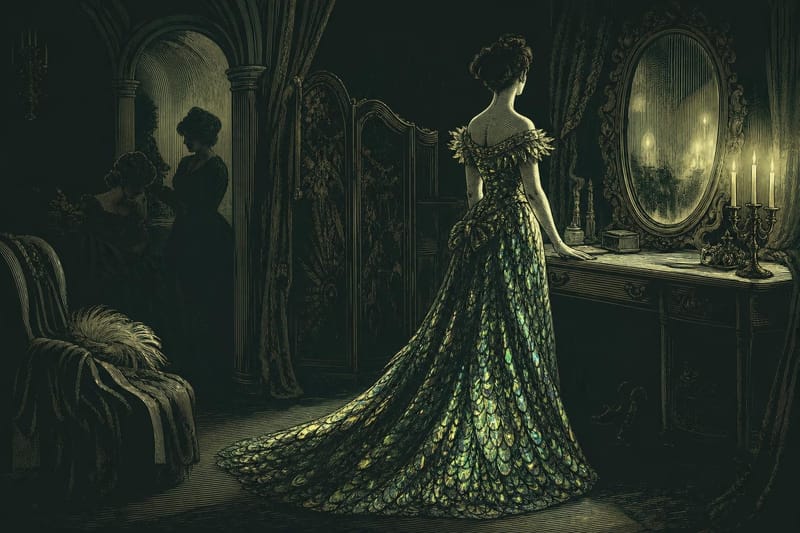
The partnership of Ellen Terry and Henry Irving lasted into the new century. He was the tragedian, intense and calculating; she was the natural, apparently spontaneous one, at her best in comedy and in parts that let her warmth show. Her Portia and her Beatrice in Much Ado About Nothing were the performances audiences returned for. Her Lady Macbeth, in 1888, was more controversial, and it produced the most famous image of her: John Singer Sargent’s 1889 portrait of the actress Ellen Terry in a green dress sewn with iridescent beetle wings, now at Tate Britain.
The dynamic between them is what Hare’s play is built on. Terry admired Irving and worked tirelessly for him, but she also saw what his management cost: new plays turned down, modern writers kept out, her own range limited to what suited him. The page on Henry Irving follows his side of the story.
Shaw, the letters and the new century
From 1892 Terry carried on a long correspondence with George Bernard Shaw, who adored the actress Ellen Terry and wanted her to leave Irving for the new drama. The letters, published after her death, are among the liveliest documents of the period, and the sharpest outside view of Ellen Terry and Henry Irving as a partnership. Shaw wrote Captain Brassbound’s Conversion with her in mind, and she eventually played it in 1906.
After the Lyceum she tried management herself. In 1903 she took over the Imperial Theatre with a production designed by her son Edward Gordon Craig; it was a financial failure. She toured, lectured on Shakespeare’s heroines, and between 1916 and 1922 appeared in several films. In 1906 the profession marked her fiftieth year on the stage with a jubilee matinée at Drury Lane.
The Victorian actress at Smallhythe
In 1925 she was made a Dame Grand Cross of the Order of the British Empire. Her last years were spent at Smallhythe Place, a timber-framed house near Tenterden in Kent, where she died on 21 July 1928. Her daughter Edith Craig turned the house into a memorial, and it is now looked after by the National Trust, with costumes, letters and the barn theatre Edith created.
Her children are the other thread of Grace Pervades. Edith Craig, a campaigner for women’s suffrage, founded the Pioneer Players in 1911 to stage plays by and about women that the commercial theatre would not touch, and directed much of their work herself. Edward Gordon Craig became a designer and theorist whose ideas shaped the modern stage, most famously in his Hamlet with Stanislavski at the Moscow Art Theatre in 1911. For Edith, her mother’s career was proof that a woman could run things in the theatre; for Edward it was the old world he wanted to sweep away and, at the same time, the one he never stopped loving. Hare puts both versions of that inheritance on stage.
The people and the place
On Stage The Irving opposite Raison’s Terry, and the roles that led him there.Stage history
Common questions
How old was Ellen Terry when she first acted?
She was nine. In 1856 she played the boy Mamillius in The Winter's Tale in Charles Kean's company at the Princess's Theatre in London.
Who were Ellen Terry's children?
Edith Craig, born in 1869, and Edward Gordon Craig, born in 1872. Their father was the architect and designer Edward William Godwin. Edith became a director and producer; Edward became one of the most influential stage designers of the twentieth century.
When did Ellen Terry work with Henry Irving?
From 1878, when she joined his company at the Lyceum and played Ophelia to his Hamlet, until the early 1900s. For most of those years she was regarded as the leading Shakespearean actress in Britain.
Where can you see the Sargent portrait of Ellen Terry?
John Singer Sargent's portrait of her as Lady Macbeth, painted in 1889 in the beetle-wing dress she wore in the part, belongs to Tate Britain in London.
Where did Ellen Terry live and die?
Her last home was Smallhythe Place, a timber-framed house near Tenterden in Kent. She died there on 21 July 1928. The house is now cared for by the National Trust.