Haymarket, London SW1 · since 1720
Theatre Royal Haymarket: the history of the Nash playhouse and a visitor guide
Updated
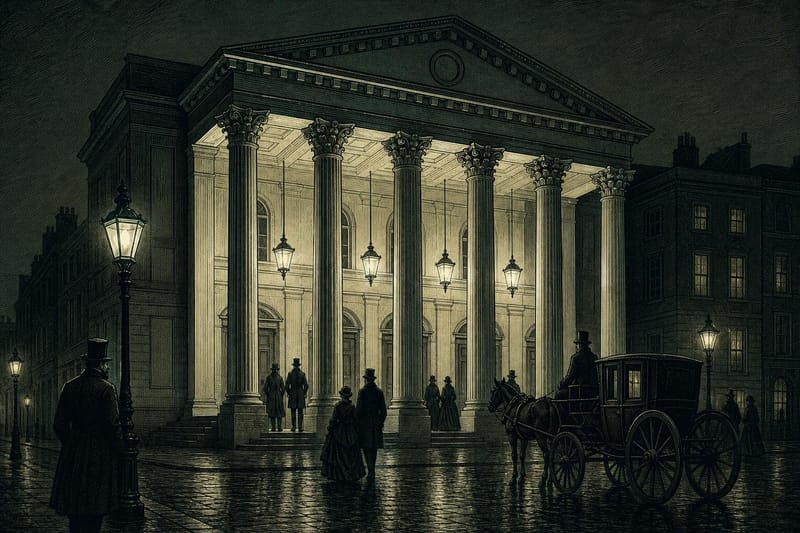
The Theatre Royal Haymarket is one of the oldest working theatres in London and one of the most handsome. Its portico of six Corinthian columns, designed by John Nash, has looked down the Haymarket since 1821, and the house behind it has seen Oscar Wilde premieres, a ghost story that refuses to die and, in 2026, Ralph Fiennes as the Victorian actor Henry Irving in David Hare’s Grace Pervades. This visitor guide covers the Theatre Royal Haymarket history from the first playhouse of 1720 to today, the auditorium and the practical side of a visit.
Theatre Royal Haymarket history: the Little Theatre of 1720
The theatre began as a speculation. In 1720 a carpenter named John Potter built a small playhouse on the Haymarket, which opened on 29 December and soon became known as the Little Theatre in the Hay. It had no royal licence, and for its first decades it lived on the edge of the law, a home for satire, foreign companies and anything the two patent houses, Drury Lane and Covent Garden, would not touch.
Its fortunes changed with Samuel Foote, an actor and satirist who took the lease in 1747. In 1766 Foote obtained a royal patent to stage spoken drama during the summer months, when the big houses were closed, and on 14 May 1767 he reopened the enlarged building as the Theatre Royal. In 1777 he sold the theatre and its patent to the playwright George Colman the Elder, whose family ran it for years afterwards.
John Nash and the 1821 building
By the 1810s the old theatre was too small, and the Regency rebuilding of the West End gave it a new site. John Nash, the architect of Regent Street, designed a new Theatre Royal Haymarket slightly south of the original, placing its portico so that it closes the view along Charles II Street from St James’s Square. It opened on 4 July 1821 with Sheridan’s The Rivals. The building is now Grade I listed.
The inside has been remade more than once. In 1879 and 1880 Squire and Marie Bancroft took over, removed the old pit in favour of stalls and put in a picture-frame proscenium, one of the first in London; they reopened on 31 January 1880 with Money. In 1904 and 1905 the architect C. Stanley Peach rebuilt the auditorium in the gilded Louis XVI style it still has, and a refurbishment in 1994 restored it again.
Buckstone, Beerbohm Tree and Wilde
The nineteenth century gave the Haymarket its character. John Baldwin Buckstone, manager from 1853 until the 1870s, made it the leading comedy house in London, and his ghost is said to haunt it still, appearing in the wings when a comedy is playing. The theatre also staged the first scheduled matinée in 1873, an idea the rest of the West End quickly adopted.
In the late 1880s Herbert Beerbohm Tree took over the house, installed electric light and premiered two Oscar Wilde comedies: A Woman of No Importance in 1893 and An Ideal Husband in 1895. The profits of his production of Trilby paid for Her Majesty’s Theatre across the road, and Tree went on to found the academy that became RADA.
The twentieth century and today
J. M. Barrie’s Mary Rose had a long run in 1920. John Gielgud directed a string of productions in the 1940s, including Tennessee Williams’s The Glass Menagerie; Peter Hall directed An Ideal Husband there in 1996 and A Streetcar Named Desire the following year. More recently the theatre has housed two productions of Waiting for Godot, One Man, Two Guvnors and Only Fools and Horses The Musical, which passed 1,000 performances, the longest run in the building’s history. In 2019 Access Entertainment bought the theatre; the freehold belongs to the Crown Estate.
The Theatre Royal Haymarket history and the story of Grace Pervades meet in an obvious way. Henry Irving’s career belonged to the Lyceum a short walk away, but the Haymarket is one of the few London houses of his era that still looks much as Irving would have known it, which made it a natural home for a play about the Victorian stage.
Theatre Royal Haymarket seating and the auditorium
Theatre Royal Haymarket seating holds 888 people on four levels. The stalls slope gently down towards the stage; above them sit the royal circle, the upper circle and the gallery, stacked steeply in the horseshoe of a nineteenth-century house. Theatre Royal Haymarket seating keeps the audience close to the stage on every level, which is a large part of its appeal for plays.
Visitor guide: getting there
The last part of this visitor guide is the simplest. The theatre stands on the Haymarket, the street that runs down from Piccadilly Circus towards Pall Mall and Trafalgar Square. Piccadilly Circus station, on the Piccadilly and Bakerloo lines, is a few minutes’ walk away; Charing Cross, for national rail and the Northern and Bakerloo lines, is a little further, past the National Gallery. The stage door is on Suffolk Street behind the building. Leicester Square, the National Portrait Gallery and Irving’s own statue on Charing Cross Road are all within ten minutes on foot.
Common questions
How old is the Theatre Royal Haymarket?
A theatre has stood on the Haymarket since 1720, when John Potter built the first one. The present building by John Nash opened on 4 July 1821, a little south of the original site, which makes it the third-oldest London playhouse still in use.
How many seats does the Theatre Royal Haymarket have?
It seats 888 people on four levels: the stalls, the royal circle, the upper circle and the gallery.
What is the nearest Tube station to the Theatre Royal Haymarket?
Piccadilly Circus, on the Piccadilly and Bakerloo lines, is a few minutes' walk up the Haymarket. Charing Cross, for mainline trains and the Northern and Bakerloo lines, is a short walk past Trafalgar Square.
Is the Theatre Royal Haymarket haunted?
Theatre lore says the ghost of John Baldwin Buckstone, manager from 1853, is seen in the wings and dressing rooms, usually during comedies. It is a story, not a record, but it has been told for well over a century.
Which famous plays premiered at the Theatre Royal Haymarket?
Among them are Oscar Wilde's A Woman of No Importance in 1893 and An Ideal Husband in 1895, both under Herbert Beerbohm Tree's management, and J. M. Barrie's Mary Rose in 1920.
When was Grace Pervades at the Theatre Royal Haymarket?
David Hare's play, with Ralph Fiennes as Henry Irving and Miranda Raison as Ellen Terry, ran there from 24 April to 11 July 2026.