Actor-manager · 1838–1905
Henry Irving: the Victorian actor who made the Lyceum famous in London
Under him the Lyceum became the most famous theatre in London, and he became the first actor to be knighted.
Updated
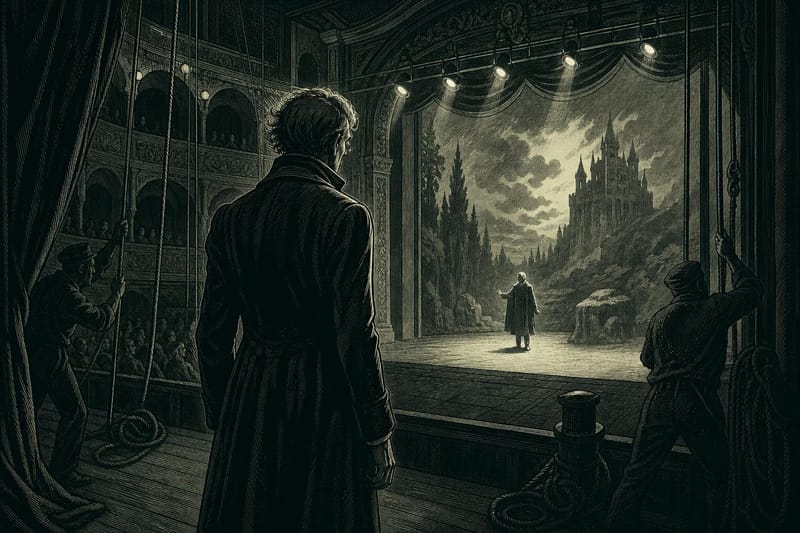
Sir Henry Irving was the actor who made the Victorian theatre respectable. When he started out in the 1850s, acting was a trade with a doubtful reputation; when he died in 1905 he had been knighted, buried in Westminster Abbey and mourned in the newspapers like a statesman. Between those two points lies the career that David Hare puts on stage in Grace Pervades, where Ralph Fiennes plays him as a man of enormous gifts and very little ease.
From John Brodribb to Henry Irving the actor
He was born John Henry Brodribb on 6 February 1838 in Keinton Mandeville, a village in Somerset, and grew up partly in Cornwall and partly in London, where he worked as a clerk. In 1856 he paid to play Romeo in an amateur performance, took the stage name Henry Irving, and that September made his professional debut in Sunderland in Bulwer-Lytton’s Richelieu.
What followed was ten years of provincial stock companies, the hard school of the period: a new part almost every week, little rehearsal and audiences that let an actor know exactly what they thought. Irving was not a natural. He was thin, his voice was odd, his walk was mocked, and he learned to turn all of it into a style. His London breakthrough came in June 1870 as the absurd Digby Grant in Two Roses at the Vaudeville, which ran for 294 performances.
The Bells and the Lyceum years
The part that made him came a year later. In November 1871, at the Lyceum, Irving played Mathias in The Bells, a melodrama about a respected burgomaster haunted by the memory of a murder he committed years before. Audiences had never seen guilt played with that intensity, and the production ran for about 150 performances. Irving played Mathias for the rest of his life.
When the Lyceum’s manager, H. L. Bateman, died in 1875, his widow kept the theatre going, and in August 1878 she handed the management to Irving. He reopened the house on 30 December 1878 with Hamlet, a part he had already played there for more than 200 nights, and with a new Ophelia: Ellen Terry. Henry Irving at the Lyceum, with Terry as his leading lady, became the most famous theatre company in the English-speaking world for the next two decades.
The Lyceum under Irving was known for spectacle as much as acting. Scenery was painted on a huge scale, gas and later limelight were handled with great care, and every production was planned to the last detail by Irving himself. His Shylock, his Mephistopheles in Faust and his Becket, Tennyson’s play, sat alongside the old melodramas. He took the company to North America for the first time in 1883 and returned there repeatedly.
Bram Stoker, Ellen Terry and the company
Two people defined Irving’s working life. Bram Stoker, an Irish civil servant and theatre critic, became his business manager in 1878 and stayed with him until his death; Stoker’s novel Dracula, published in 1897, has often been read as a portrait of his imperious employer, and in 1906 he published a two-volume memoir of Irving. The other was Terry, whose partnership with him is the heart of Grace Pervades. The page on Ellen Terry follows her side of it.
Irving was not loved by everyone. George Bernard Shaw, writing as a critic, admired Terry and attacked Irving for cutting Shakespeare and ignoring new writers like Ibsen. Hare puts that argument into the play: an actor-manager who built a temple to the old theatre while the new one was being written around him.
The first actor knighted
In 1895 Irving became Sir Henry Irving, the first actor ever to be knighted, at a ceremony at Windsor on 18 July. For the profession it was a turning point: an actor could now sit in the same company as painters, writers and politicians. Irving accepted the honour as recognition of the stage, and most of his colleagues saw it the same way.
Decline and death on tour
The last years were hard. In 1898 a fire in a warehouse destroyed the scenery for dozens of productions, worth over £30,000, and a run of expensive failures followed. In April 1899 the Lyceum was turned into a limited company, and in 1902, faced with debts and safety work demanded by the London County Council, Irving left it. The era of Henry Irving at the Lyceum was over; the building was largely rebuilt in 1904 as a variety house. He moved his company to Drury Lane and spent his last seasons touring the provinces.
In October 1905, in Bradford, he gave a performance of Becket, collapsed at his hotel afterwards and died. He was 67. His ashes were buried in Westminster Abbey on 20 October 1905, and in December 1910 a bronze statue by Thomas Brock was unveiled outside the National Portrait Gallery, where it still stands. Henry Irving the actor is remembered less for any single performance than for what he made of the job: a profession, with a knighthood at the end of it.
The people and the place
On Stage The actor who played Irving in Grace Pervades, and his other stage parts since 1985.Stage history
Common questions
Was Henry Irving the first actor to be knighted?
Yes. Irving was knighted in 1895, the first actor to receive the honour. The ceremony took place at Windsor on 18 July that year.
What was Henry Irving's real name?
He was born John Henry Brodribb on 6 February 1838 in Keinton Mandeville, Somerset, and took the name Henry Irving when he went on the stage in 1856.
How long did Henry Irving run the Lyceum?
Irving took over the management of the Lyceum in August 1878 and reopened it that December. He stayed until 1902, when debts, a warehouse fire that destroyed his scenery and new safety demands from the London County Council ended his time there.
What was the connection between Henry Irving and Bram Stoker?
Bram Stoker was Irving's business manager at the Lyceum for most of the actor's career there, and published a two-volume memoir of him in 1906. Irving is often named as one of the inspirations for Count Dracula.
Where is Henry Irving buried?
His ashes were buried in Westminster Abbey on 20 October 1905. A bronze statue by Thomas Brock stands outside the National Portrait Gallery in London.